All in - 05/08/2026

Last month, we explored why strength training 2–3 times per week is one of the most powerful things you can do for your long-term health. But strength is just one piece of the puzzle.
If your goal is to feel energised, reduce your risk of chronic disease, improve mental clarity, and stay mobile and independent well into your later years, you need a well-rounded movement routine—one that goes beyond just strengthening to support cardiovascular health, mobility, mental wellbeing, and recovery.
So, how often should you be exercising each week?
Let’s break it down, based on current evidence—and show you how All for One classes make it easy to build a balanced, effective, and enjoyable routine.
According to the Australian Department of Health and World Health Organization, adults should aim for:
150–300 minutes of moderate-intensity aerobic activity or 75–150 minutes of vigorous-intensity activity per week
Muscle-strengthening activities on 2 or more days per week
Regular flexibility and mobility exercises
Minimising sedentary time and breaking up long sitting periods
These recommendations aren’t about pushing to the extreme—they’re about creating sustainable habits that protect your physical and mental wellbeing across your lifespan.
We covered this in detail in last month’s article, but to recap: regular strength training improves bone density, joint health, muscle mass, posture, and metabolic function. It also plays a vital role in reducing the risk of falls and injuries, especially as we age.
According to a 2022 meta-analysis published in the British Journal of Sports Medicine, just 30–60 minutes of strength training per week is associated with a 10–20% lower risk of all-cause mortality, cardiovascular disease, and cancer.
At All for One, we recommend:
STRONGER – Our new progressive strength class for lifting heavier with proper form
Reformer Pilates – Low-impact strength and stability using spring-based resistance
Strength – Blending functional strength and cardio conditioning
Cardio is essential for maintaining a healthy heart, lungs, and circulatory system. It boosts endurance, supports metabolism, and improves mood by releasing endorphins.
Studies have shown that regular aerobic activity is linked to reduced risk of stroke, hypertension, type 2 diabetes, dementia, and depression.
You don’t need to run marathons—movement like brisk walking, cycling, or dynamic classes counts too.
Try at All for One:
Spin – High-energy indoor cycling that’s easy on the joints
Conditioning – A full-body session that gets the heart rate up while building power
Yoga Flow – A gentler way to move and raise your heart rate, especially when paired with mindful breathwork
One of the most overlooked elements of a balanced exercise routine is recovery and mobility.
Incorporating flexibility work and restorative movement not only supports joint health, posture, and performance—but also helps regulate the nervous system, reduce stress, and prevent injury. Chronic stress and overtraining can contribute to burnout, fatigue, and hormonal imbalance—so balancing intensity with rest is key.
Try:
Yoga (Yin, Slow Flow, or Stretch) – To release tension, support circulation, and reconnect with your breath
Infrared Sauna – Enhances recovery, detoxification, and relaxation
Walks or light mobility flows – Great on rest days to stay active without overloading
The goal isn’t perfection—it’s consistency and variety. Here’s an example of a balanced All for One week:
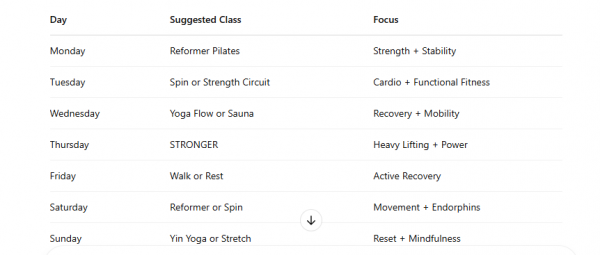
At All for One, we believe movement should support your whole health—body, mind, and life. We don’t push fads or extremes. Instead, we help you build routines that feel good, make sense for your life, and grow with you over time.
Whether you’re just starting out, returning from injury, pregnant or postnatal, or chasing new strength goals—we’ve designed our classes to meet you where you’re at and support your journey every step of the way.
Want help mapping out your ideal week? Just ask our team. We’re here to help you build a routine that’s strong, balanced, and sustainable—for life.
All in - 05/08/2026
Prefer to talk? Yarraville (03) 8319 9945 · Hampton East (03) 9086 3740 · Kensington (03) 8319 9946
Please don’t include medical or health information in this form. For clinical questions or appointments, call your studio or book online. Your message goes straight to the studio you choose.
This site is protected by reCAPTCHA and the Google Privacy Policy and Terms of Service apply.

Specialist care from physios who truly understand women’s bodies.

Senior Women’s Health Physiotherapist
Emily has a deep passion for empowering women to take control of their pelvic health. She creates a warm, judgement-free space where you can talk openly about what’s really going on.
With advanced training in pelvic floor rehabilitation, Emily treats a wide range of conditions including incontinence, prolapse, pelvic pain, and pregnancy-related concerns. She takes the time to really listen, explain what’s happening in your body, and build a treatment plan that fits your life. Whether you’re preparing for birth, recovering postpartum, or navigating menopause — Emily is here to help you feel strong and confident again.

Women’s Health Physiotherapist
Tori is passionate about helping women feel heard and supported through every stage of life. She combines clinical expertise with genuine empathy to deliver care that makes a real difference.
Tori brings a holistic, evidence-based approach to treating pelvic floor dysfunction, pregnancy-related pain, and postnatal recovery. She has a special interest in helping women return to exercise safely after having a baby and supporting those with persistent pelvic pain. Tori believes every woman deserves to understand her body and feel empowered in her recovery — no topic is too awkward, and no concern is too small.