Clinical Pilates vs Reformer Pilates: What’s the Difference?
Not sure which type of Pilates you actually need? Here's how to tell.

They share a name, they share the equipment — but they’re built for very different things. Here’s what you actually need to know.
If you’ve ever been told to “try Pilates” by a GP, a friend, or someone on the internet, you’ve probably hit the same wall everyone hits: which Pilates? A quick search turns up reformer classes, clinical sessions, mat Pilates, studio Pilates, and a dozen variations that all seem to involve lying on a machine and doing things with springs. It’s not obvious what the differences are, or which one is right for you.
At All for One in Hampton East and Yarraville, we run both clinical Pilates and reformer Pilates — and the question of which one someone needs comes up almost daily. The short answer is that they serve different purposes. The longer answer is worth understanding, because choosing the right one makes a real difference to your results.
Clinical Pilates is a form of exercise-based rehabilitation led by a physiotherapist. It uses Pilates principles — controlled movement, core engagement, alignment — but applies them within a clinical framework, with exercises selected and progressed based on a thorough assessment of your body, your injury, and your goals.
The first thing that separates clinical Pilates from a standard class is the entry point. Before you touch a reformer, your physiotherapist assesses how you move — where you’re strong, where you’re compensating, what your body is actually doing versus what it should be doing. From there, your program is built specifically for you. Two people with the same diagnosis might end up with completely different exercises depending on how their body presents.
Because your program is individualised, you’re always working at the right level — not holding back because the class is too advanced, and not coasting because it’s too easy. Every exercise is there for a reason, and your physio adjusts the program as your strength and movement quality change. Every six weeks, you’ll have a one-on-one review with your physiotherapist to reassess your progress, update your goals, and make sure your program is still matched to where your body is now. That kind of structured progression is something an open group class simply can’t replicate.
Clinical Pilates sessions at All for One are run in small groups of up to four people. That ratio exists for a reason: your physio needs to watch how you move, correct your form in real time, and adjust your program as you progress. It’s not a class you attend — it’s a treatment session that happens to involve a reformer.
Research supports the value of that supervision. A 2024 randomised controlled trial published in Clinical Rehabilitation found that supervised Pilates produced significantly better outcomes for pain, disability, and quality of life compared to unsupervised home-based exercise in people with chronic low back pain (Tottoli et al., 2024). The supervision isn’t a luxury — it’s part of what makes clinical Pilates effective.
Clinical Pilates is typically the right starting point if you’re managing an injury, recovering from surgery, dealing with chronic pain, or returning to movement after a long time away from exercise, which is what brings most people to us for Clinical Pilates from Brighton East. If you haven’t been active in a while and want to start with a higher level of care — someone watching your movement closely, building your confidence, and making sure you’re not guessing — clinical Pilates gives you that foundation. It’s also where your GP is probably pointing you when they write “Pilates” on a referral, even if they don’t specify the type.
The evidence base here is strong. A 2023 systematic review and meta-analysis examining over 1,100 patients found that clinical Pilates produced significant improvements in pain, functional capacity, and quality of life in people with chronic low back pain (Fernández-Rodríguez et al., 2023). A separate 2018 systematic review of 23 studies found Pilates more effective than control interventions in 19 of them, including for post-surgical rehabilitation (Wells et al., 2018). These aren’t fringe findings — they’re consistent across multiple high-quality reviews.
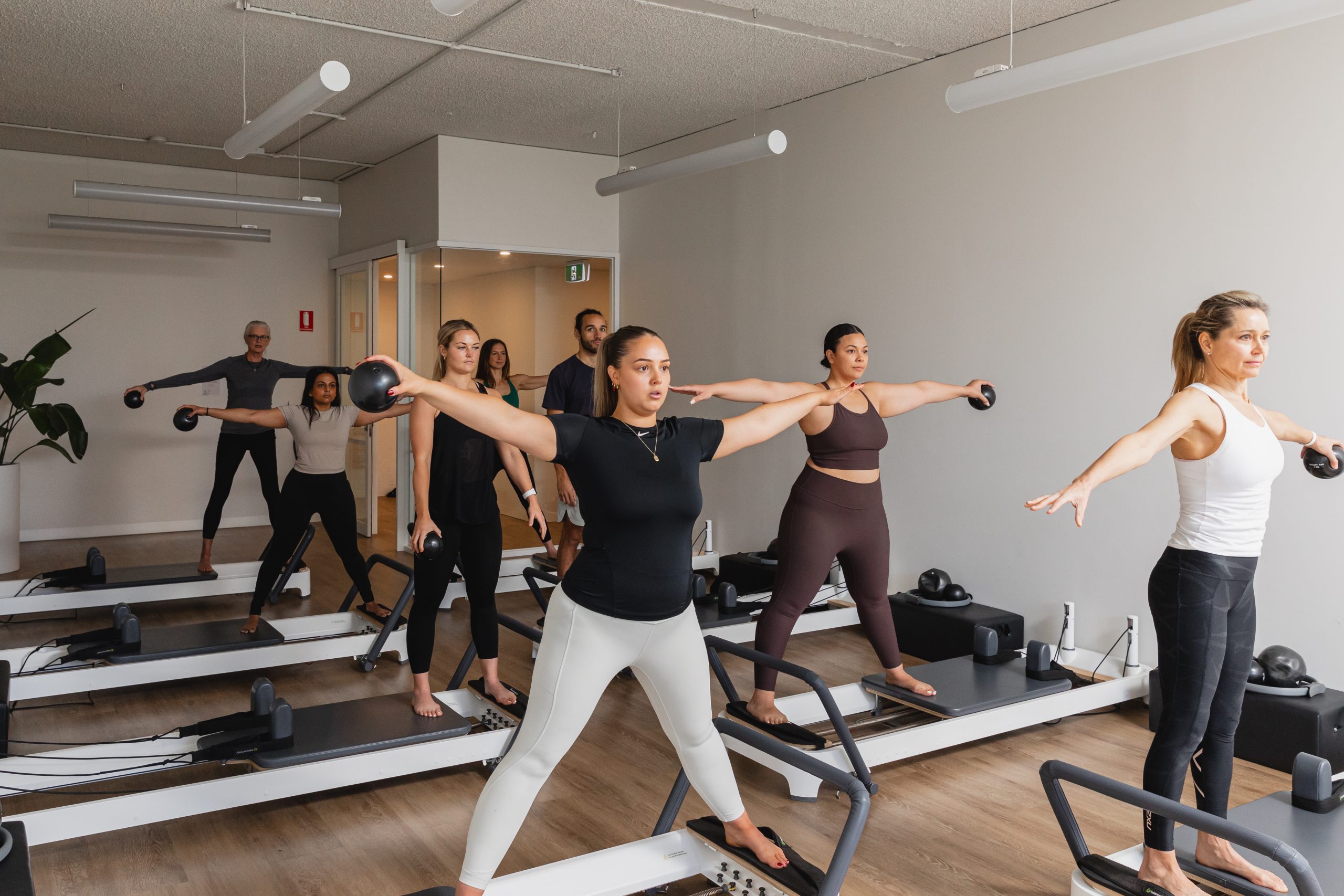
Reformer Pilates is a group fitness class performed on a reformer machine — the same piece of equipment used in clinical sessions, but in a different context. Classes are typically larger, the exercises are standardised across the group, and the focus shifts from rehabilitation to strength, mobility, and movement quality, which is what most people are after when they go looking for Reformer Pilates in Moorabbin.
In a reformer Pilates class, everyone works through the same sequence of exercises, with the instructor cueing modifications where needed. It’s structured, it’s challenging, and it builds genuine strength — but it’s not designed around your specific injury or rehab needs. The instructor is qualified in Pilates, but they’re not assessing your movement patterns or managing a clinical condition.
Reformer Pilates is a great option if you’re generally healthy, want to build strength and flexibility, or you’ve graduated from clinical Pilates and want to keep moving in a group environment. It’s one of the fastest-growing forms of exercise in Australia — over a million Australians participated in Pilates in 2023, with reformer-based classes a significant part of that growth.
This is where the confusion starts. A GP writes “Pilates” on a care plan or mentions it in a consult, and the patient books into the first reformer class they can find. It’s understandable — from the outside, Pilates is Pilates. But a group reformer class and a physio-led clinical session are fundamentally different experiences, and for someone carrying an injury or managing a condition, that distinction matters.
When a GP refers you to Pilates for a specific issue — a disc bulge, post-surgical rehab, persistent hip pain — they’re almost always referring to clinical Pilates with a physiotherapist. The individualised assessment, the small group ratio, and the clinical reasoning behind the exercise selection are what make it therapeutic rather than just exercise.
If you’ve been given a Pilates recommendation and you’re not sure which type, start with a physiotherapy assessment. Your physio can tell you whether clinical Pilates is the right entry point or whether you’re ready to go straight into reformer classes.
One of the most common misconceptions is that clinical Pilates and reformer Pilates are two versions of the same thing, and you just pick whichever suits your schedule. In reality, they often work as a sequence.
At All for One, many of our clients start in clinical Pilates while they’re working through an injury with their physio. As they build strength, improve their movement patterns, and reach the point where they no longer need that close clinical oversight, they transition into reformer classes, which is the usual progression for people who start with us for Pilates in Hampton. It’s not a downgrade — it’s a progression. It means your body is ready for more volume, more variety, and more independence in how you move.
Because All for One’s physiotherapists run both clinical Pilates and work alongside the reformer Pilates team, that transition isn’t a referral to a separate business or a guess about whether you’re ready. Your physio knows your history, knows what you’ve been working on, and can recommend the right class format and level for where you are now. That continuity is one of the advantages of having both under the same roof.
Rather than a checklist, think about it this way:
Start with clinical Pilates if you’re dealing with pain, recovering from an injury or surgery, have been referred by a GP or specialist, or haven’t exercised in a long time and want a guided, closely supervised re-entry point with a higher level of care. Clinical Pilates gives you the assessment, the supervision, and the individualised programming to address what’s actually going on in your body — and regular one-on-one reviews to make sure it keeps evolving with you.
Start with reformer Pilates if you’re injury-free, you’ve done Pilates or strength training before, or you’ve been cleared by a physio and want a challenging group class. Reformer Pilates builds strength, flexibility, and body awareness in a format that keeps you consistent because it’s genuinely enjoyable.
Not sure? Book a physiotherapy assessment. That’s the simplest way to get a clear recommendation based on your body, not a guess based on a Google search.
Whether you start with clinical Pilates, reformer Pilates, or a combination of both, the goal is the same: a body that moves well, feels strong, and can handle what you ask of it. At All for One, we see these two services not as separate offerings but as parts of the same continuum — one that starts wherever you are and moves with you as you get stronger.
That’s the real answer to the clinical-vs-reformer question. It’s not about which one is better. It’s about which one is right for you, right now — and having a team that can guide you from one to the other when the time comes.
Book a physiotherapy assessment at All for One in Hampton East or Yarraville to find out which type of Pilates is right for where you are now.
Clinical Pilates is a rehabilitation-focused form of Pilates led by a physiotherapist, with exercises tailored to your specific injury or condition. Reformer Pilates is a group fitness class performed on reformer machines, designed for general strength and flexibility rather than injury management.
Neither is better — they serve different purposes. Clinical Pilates is the right choice if you’re managing an injury, recovering from surgery, or need individualised programming. Reformer Pilates is ideal for general fitness, strength, and flexibility in a group class setting.
You don’t need a formal referral to book clinical Pilates at All for One, but a physiotherapy assessment is the first step. This allows your physio to design a program specific to your body and your goals. If you have a GP referral or care plan, bring it along.
It depends on the injury. Some injuries can be managed in a reformer class with modifications, but many require the closer supervision and tailored programming of clinical Pilates first. A physiotherapy assessment is the best way to determine which is appropriate for you.
At All for One, clinical Pilates sessions are run in small groups of up to four people, supervised by a physiotherapist. Your program is designed specifically for you based on a thorough movement assessment, and exercises are progressed as your strength and control improve. Every six weeks, you’ll have a one-on-one review to reassess your progress and update your program.
For clinical Pilates, two sessions per week is typical and well-supported by research — a 2016 randomised controlled trial found twice weekly more effective than once weekly, with no additional benefit from a third session (Phrompaet et al., 2016). For reformer Pilates, two to three sessions per week is a good baseline for building strength and consistency. Your physio can recommend the right frequency based on your goals.
All for One offers both clinical Pilates and reformer Pilates at two Melbourne locations: Hampton East and Yarraville. Both studios have physiotherapists who can assess your needs and guide you into the right type of session. Book at allforone.com.au.
There is strong evidence that clinical Pilates, supervised by a physiotherapist, reduces both pain and disability in people with chronic low back pain. It works by building core strength, improving spinal stability, and retraining movement patterns — research shows it helps retrain the timing and activation of deep stabilising muscles that are often impaired in chronic pain (PMC, 2023). If back pain is your main concern, start with a physio assessment rather than a general class.
Fernández-Rodríguez, R. et al. (2023). Efficacy of Pilates on pain, functional disorders and quality of life in patients with chronic low back pain: a systematic review and meta-analysis. International Journal of Environmental Research and Public Health, 20(4), 2850.
Tottoli, C.R. et al. (2024). Effectiveness of Pilates compared with home-based exercises in individuals with chronic non-specific low back pain: randomised controlled trial. Clinical Rehabilitation, 38(11).
Phrompaet, S. et al. (2016). Effectiveness and cost-effectiveness of different weekly frequencies of Pilates for chronic low back pain: randomised controlled trial. Physical Therapy, 96(3), 382–389.
Wells, C. et al. (2018). Is Pilates an effective rehabilitation tool? A systematic review. Journal of Bodywork and Movement Therapies.
Pilates to improve core muscle activation in chronic low back pain: a systematic review (2023). PMC.
Physiotherapy - 15/08/2026
Prefer to talk? Yarraville (03) 8319 9945 · Hampton East (03) 9086 3740 · Kensington (03) 8319 9946
Please don’t include medical or health information in this form. For clinical questions or appointments, call your studio or book online. Your message goes straight to the studio you choose.
This site is protected by reCAPTCHA and the Google Privacy Policy and Terms of Service apply.

Specialist care from physios who truly understand women’s bodies.

Senior Women’s Health Physiotherapist
Emily has a deep passion for empowering women to take control of their pelvic health. She creates a warm, judgement-free space where you can talk openly about what’s really going on.
With advanced training in pelvic floor rehabilitation, Emily treats a wide range of conditions including incontinence, prolapse, pelvic pain, and pregnancy-related concerns. She takes the time to really listen, explain what’s happening in your body, and build a treatment plan that fits your life. Whether you’re preparing for birth, recovering postpartum, or navigating menopause — Emily is here to help you feel strong and confident again.

Women’s Health Physiotherapist
Tori is passionate about helping women feel heard and supported through every stage of life. She combines clinical expertise with genuine empathy to deliver care that makes a real difference.
Tori brings a holistic, evidence-based approach to treating pelvic floor dysfunction, pregnancy-related pain, and postnatal recovery. She has a special interest in helping women return to exercise safely after having a baby and supporting those with persistent pelvic pain. Tori believes every woman deserves to understand her body and feel empowered in her recovery — no topic is too awkward, and no concern is too small.