Spinal Scans Explained
Have you had a scan on your back and confused what it all means?

If you have back or neck pain you may have had a scan of your back and be wanting to better understand what the results mean. You’re not alone. Spinal X-rays, CT scans, and MRI reports use terminology that is unfamiliar to most people and can sound intimidating and leave you feeling like something is wrong, even if the results are completely normal.
When you get a scan, the image is interpreted by a doctor or radiologist (a doctor that specialises in interpreting imaging). They write a report commenting on each spinal level in question which will look something like this:
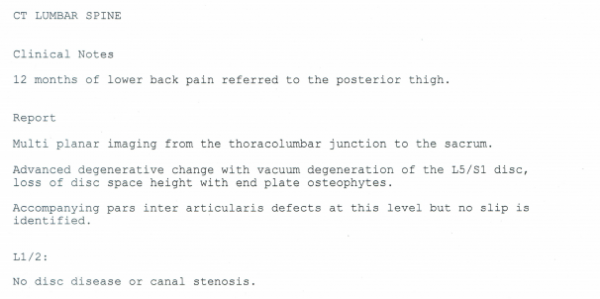
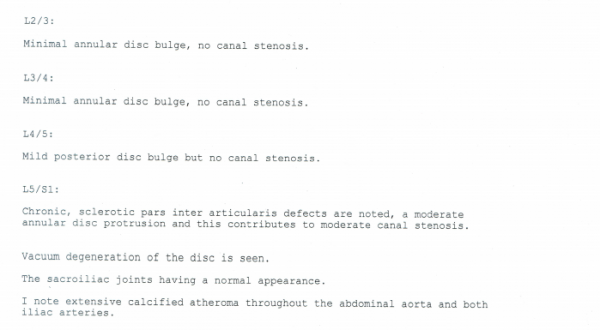
This report is typically what is given to patients to explain their results, but what does it mean?
Stenosis: narrowing of the joint space. Just because the joint space is narrowed, does not always mean the nerves are compromised.
Degeneration: degenerative changes are often seen in the spine in the form of:
“loss of disc height”
“plate osteophytes” (small bone bumps)
“sclerosis” (thickened bone)
“spondylosis” (medical term for age-related changes in the spine, like grey hairs or wrinkles).
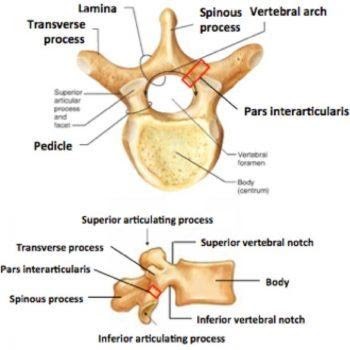
Pars interarticularis, facet, lamina, pedicle, etc are all just anatomical parts of the vertebrae themselves
Around 1 in 3 Australians will experience back pain at some point in their lives (Aus Institute of Health and Wellness, 2019). Of these people, only 1-2% will have a serious or systemic pathology (cancer, fracture, inflammatory disorder, or infection), 5-10% will have significant neurological compromise (cord compression, cauda equina syndrome, sciatica related to a disc prolapse, or symptomatic spondylolisthesis), and 90% have what is termed “non-specific low back pain” which can be influenced by many factors such as minor ligamentous sprains, muscle tension, fear of movement, abnormal movement, stress, sleep, diet, etc.
To demonstrate, here are some of the imaging findings in normal, pain-free spines:
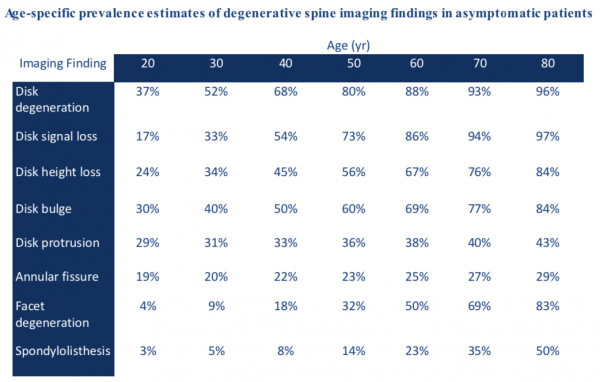
In fact, the CT report above is from a patient with a completely healthy back, whose pain was eased completely following a cardiac procedure to address the plaques in their arteries.
If you are experiencing back pain, speak with a health professional who can help rule out any serious pathologies, address factors that may be contributing, and get you on track to controlling your back pain.
Physiotherapy - 15/08/2026

Prefer to talk? Yarraville (03) 8319 9945 · Hampton East (03) 9086 3740 · Kensington (03) 8319 9946
Please don’t include medical or health information in this form. For clinical questions or appointments, call your studio or book online. Your message goes straight to the studio you choose.
This site is protected by reCAPTCHA and the Google Privacy Policy and Terms of Service apply.

Specialist care from physios who truly understand women’s bodies.

Senior Women’s Health Physiotherapist
Emily has a deep passion for empowering women to take control of their pelvic health. She creates a warm, judgement-free space where you can talk openly about what’s really going on.
With advanced training in pelvic floor rehabilitation, Emily treats a wide range of conditions including incontinence, prolapse, pelvic pain, and pregnancy-related concerns. She takes the time to really listen, explain what’s happening in your body, and build a treatment plan that fits your life. Whether you’re preparing for birth, recovering postpartum, or navigating menopause — Emily is here to help you feel strong and confident again.

Women’s Health Physiotherapist
Tori is passionate about helping women feel heard and supported through every stage of life. She combines clinical expertise with genuine empathy to deliver care that makes a real difference.
Tori brings a holistic, evidence-based approach to treating pelvic floor dysfunction, pregnancy-related pain, and postnatal recovery. She has a special interest in helping women return to exercise safely after having a baby and supporting those with persistent pelvic pain. Tori believes every woman deserves to understand her body and feel empowered in her recovery — no topic is too awkward, and no concern is too small.