Why Do My Knees Hurt Going Down Stairs (But Not Up)?
The answer surprises most people. Going down loads your knees five to eight times your bodyweight, and the muscles doing most of the work aren't in the knee at all.

The answer surprises most people. Going down loads your knees five to eight times your bodyweight, and the muscles doing most of the work aren’t in the knee at all.
You walk up a flight of stairs fine. Coming back down, your knee complains. It’s an annoyingly common pattern, and it doesn’t always make sense at first. Going up feels harder, so surely going up should be the part that hurts.
The biomechanics actually work the other way, and most people we see in clinic with this pattern are surprised once we explain what’s going on. The good news is the fix is usually clear, and it usually isn’t in the knee.
The numbers on this are more dramatic than most people realise.
Walking on a flat surface loads your knees with about 1 to 1.5 times your bodyweight per step. Going up stairs loads them with around 3 to 4 times your bodyweight. Going down stairs loads them with 5 to 8 times your bodyweight, depending on the step height and how you take it. That’s a significant jump, and it’s the reason a knee that copes fine with everyday walking can suddenly object on the way back down to the kitchen.
The reason for the extra load is what your quadriceps are doing. Going up stairs, your quads contract concentrically (shortening as they pull). They’re the engine. Going down stairs, the same muscles contract eccentrically (lengthening under load while trying to slow you down). They’re the brakes. Eccentric work generates significantly more force on the joint surface than concentric work, and the deeper knee bend involved in stepping down further amplifies the compression on the kneecap.
So your knees are absorbing roughly twice the load on descent, in a deeper bend, with the muscles working in their highest-force mode. That’s the basic answer to why going down hurts and going up doesn’t.
The pain itself usually comes from the patellofemoral joint, which is the joint between the kneecap and the groove in the front of your thighbone.
When your quadriceps brake your descent, they pull the kneecap firmly into that groove. If the kneecap is tracking nicely down the centre, the load distributes across a large surface area and most knees handle it without complaint. If the kneecap is tracking slightly to one side (which is common, especially in women), the same load concentrates on a smaller patch of cartilage. Repeat that ten times a day for years and the cartilage gets irritated, the surrounding tissue inflames, and stairs become the thing that reliably hurts.
The clinical name for this most of the time is patellofemoral pain syndrome, and it’s one of the most common knee complaints in adults. It affects roughly 22 percent of the general population at some point, and disproportionately women. Less commonly, the same symptom pattern can come from early changes to the cartilage itself (chondromalacia), a small meniscal tear, or the early stages of osteoarthritis. If that is what you have been told, our guide Do I need a knee replacement? What to try first explains the steps that come before surgery.
The mechanical question, in almost all of these cases, is the same. Why is the kneecap tracking off-centre.
This is the part that catches people off guard.
The kneecap doesn’t really decide where it goes. It mostly follows the line of pull of the quadriceps, which mostly follows the alignment of the thigh bone, which mostly follows what the hip is doing. When the hip is well-controlled, the thigh stays in line, the quads pull straight, and the kneecap tracks down the middle of the groove. When the hip isn’t well-controlled, particularly the muscles on the side of the hip (the gluteus medius especially), the thigh drifts inward on each step, the quads pull off-axis, and the kneecap tracks off-centre.
The research on this is unusually clear. Women with patellofemoral pain show measurable weakness in hip abduction, hip external rotation, and hip extension compared to women without it. They also show delayed firing of the gluteus medius, meaning the muscle that should stabilise the hip on each step is switching on too late. Runners with knee pain show greater hip adduction and internal rotation during running than runners without it. The further up the chain you look, the more often the actual problem is found.
This is why most people we see in clinic with stair-related knee pain don’t actually need work on their knee. They need work on their hip.
The first thing worth knowing is that rest, on its own, doesn’t fix this. The cartilage and tendons involved respond well to load (in the right form), and badly to no load at all. A knee that’s been rested for two months still has the same hip pattern and the same tracking issue when you load it again.
The treatments with the strongest evidence base are:
Hip strengthening, especially the abductors and external rotators. Side-lying clams, hip hitches, single-leg work that emphasises hip control. Most members notice a difference in stair-related knee pain within two to three weeks once they’re doing this consistently.
Eccentric quadriceps work. Slow step-downs, controlled squats with emphasis on the lowering phase, leg extensions where the slow lowering matters more than the lift. Eccentric work loads the patellofemoral joint in a controlled way and builds capacity in the exact muscles that brake your descent.
Movement retraining. Some people walk and load with their knees drifting inward (knee valgus), often invisibly to themselves. A coach or physio can usually spot the pattern in five minutes and give you a couple of cues that make a real difference.
Time, taking the right form. Most patellofemoral pain that gets a proper plan resolves over six to twelve weeks. Aggressive scans, injections and surgery are rarely the right first move for this presentation.
Most stair-related knee pain isn’t serious and responds well to the right kind of strengthening. There are a few signs that mean it’s worth coming in sooner rather than later:
For everyone else, the work is fairly low-drama. A clear assessment of where the weakness is (usually hip and quad), a handful of well-chosen exercises, and a steady return to load. You don’t have to give up stairs, and you don’t have to push through pain.
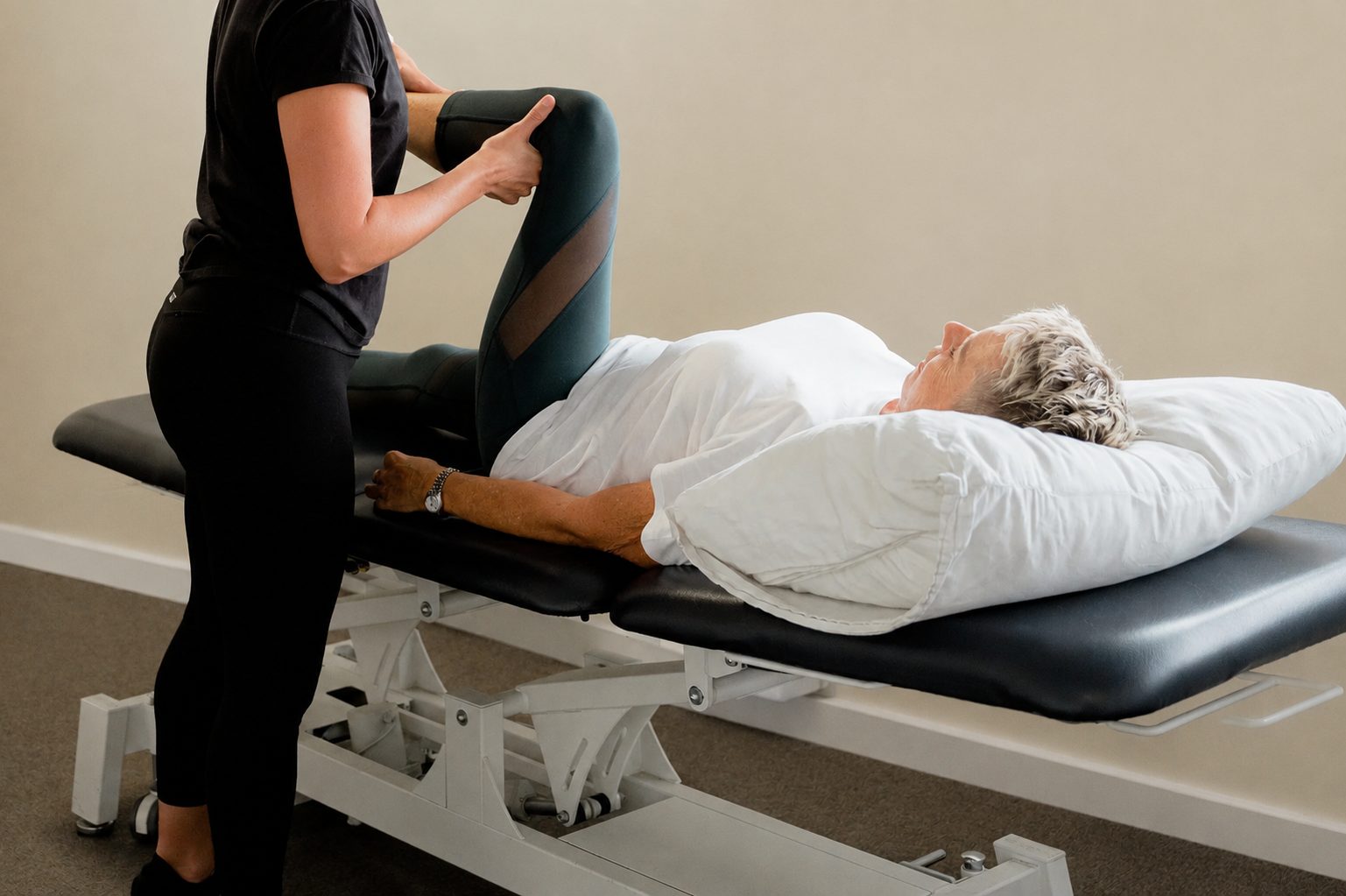
If you’ve been working around your stairs for a while, it’s worth getting it assessed. Knee pain on stairs is one of the more common things our physios see, and one of the kinds of pain that responds well to the right plan. A proper assessment looks at how the hip, knee and foot are working together, and from there the plan is built specifically for what your body needs.
We’ll meet you where you’re at, and help you build from there.
All in - 30/09/2026
All in - 30/09/2026
The common signs, how it differs from pain on the side of the hip, and what to do next.
READ MOREPrefer to talk? Yarraville (03) 8319 9945 · Hampton East (03) 9086 3740 · Kensington (03) 8319 9946
Please don’t include medical or health information in this form. For clinical questions or appointments, call your studio or book online. Your message goes straight to the studio you choose.
This site is protected by reCAPTCHA and the Google Privacy Policy and Terms of Service apply.

Specialist care from physios who truly understand women’s bodies.

Senior Women’s Health Physiotherapist
Emily has a deep passion for empowering women to take control of their pelvic health. She creates a warm, judgement-free space where you can talk openly about what’s really going on.
With advanced training in pelvic floor rehabilitation, Emily treats a wide range of conditions including incontinence, prolapse, pelvic pain, and pregnancy-related concerns. She takes the time to really listen, explain what’s happening in your body, and build a treatment plan that fits your life. Whether you’re preparing for birth, recovering postpartum, or navigating menopause — Emily is here to help you feel strong and confident again.

Women’s Health Physiotherapist
Tori is passionate about helping women feel heard and supported through every stage of life. She combines clinical expertise with genuine empathy to deliver care that makes a real difference.
Tori brings a holistic, evidence-based approach to treating pelvic floor dysfunction, pregnancy-related pain, and postnatal recovery. She has a special interest in helping women return to exercise safely after having a baby and supporting those with persistent pelvic pain. Tori believes every woman deserves to understand her body and feel empowered in her recovery — no topic is too awkward, and no concern is too small.