Knee Pain Going Up Stairs? Here’s What Your Body Is Trying to Tell You
That ache climbing stairs isn't bad luck. Here's what's actually causing it — and what to do.

Fine on the flat. Fine at your desk. Then you hit a flight of stairs and your knee tells you, loudly, that something isn’t right. That pattern is one of the most common things we see, and one of the most misread: the knee is usually reporting a problem rather than being one.
Because they are two completely different jobs for the same joint. On flat ground your knee barely bends while it is carrying you, roughly 15 to 20 degrees through the part of the stride where your weight is on it, and your body travels forward rather than upward. A stair asks for something else entirely. To lift your whole body up one step, the knee has to bend well past 60 degrees while it is loaded, and then straighten again from that position with your bodyweight sitting on top of it.
Force follows the angle. Level walking already puts a couple of times your body weight through the knee, and a step up pushes that higher again, but the number that really changes is the pressure between your kneecap and the groove it runs in. That climbs several times over on stairs, because the deeper the loaded bend, the harder the kneecap is pressed back into the joint. That is not a design flaw, it is just physics, and a healthy system handles it without comment.
So a knee that copes perfectly well walking can still be exposed the moment you take a step up. Flat walking is a low-demand task. Stairs are a strength test you take several times a day without meaning to, and they find the weak link first. If your knee is quiet on the level and vocal on the stairs, that is not a contradiction, it is the most useful clue you have.
And sharp is not the same as damaged. A sharp, pinpoint pain under or around the front of the kneecap that arrives on the step and settles soon after you stop is the classic patellofemoral pattern. It usually reflects an irritated, overloaded joint surface rather than something torn or broken. A duller, deeper ache, or pain that comes with swelling, clicking or locking, is worth a closer look, and the checklist further down tells you when. Noise on its own, with no pain and no catching, is usually far less interesting than it sounds, which is the same conclusion we reach with a shoulder that clicks.
It does, and it is worth paying attention to which one bothers you. Going up, your quadriceps work concentrically: the muscle shortens to straighten the knee and lift you onto the next step. Going down, the same muscle works eccentrically. It lengthens under load to control your descent, acting as a brake so you lower rather than drop onto the step below.
Braking is the harder of the two. Eccentric work generates higher forces than lifting does, and it presses the kneecap into its groove harder, which is why more people report pain going down than going up, and why down-stairs pain skews more strongly towards the patellofemoral joint. Plenty of people have both. If down is clearly your worse direction, we have written about that separately: why knees hurt going down stairs
Pain going up tends to point at the strength and the control that lifts you, the quads and the glutes doing the work. Pain going down tends to point at the brakes and at how well the hip steadies the leg while it is loaded, which is the same gluteal work that goes missing in lateral hip pain. Neither is a diagnosis on its own. It is a starting point, and it usually shapes the first few weeks of the program.
The common assumption is that knee pain on stairs means something is wrong with the knee. Sometimes that is true. More often the knee is the messenger, not the problem, and understanding that difference is what changes the outcome.
The most frequent contributor is weakness in the muscles that are supposed to share the load: the quadriceps, the gluteal muscles and the hip stabilisers. When those are not pulling their weight, quite literally, the knee absorbs more than its share. Over time that compensation creates irritation, and irritation creates pain. The joint is not failing; it is covering for something else.
This is also why “rest it and see how it goes” so often disappoints, and why the same spot keeps flaring up months later. Rest takes the load away for a while and the pain settles, which feels like progress. But nothing about the capacity of the muscles has changed, so the moment stairs reappear in your day, so does the pain. Rest treats the symptom. Load, applied properly, treats the cause.
The most common single source of stair-related knee pain is patellofemoral pain, sometimes called runner’s knee, although you certainly do not need to be a runner to get it. The patella, your kneecap, sits in a groove at the front of the knee and glides through it as the joint bends and straightens. Bending under load presses it into that groove, and the deeper the bend the harder the press. When the quads, glutes and hip muscles are not sharing the job, more of that load lands on the joint surface than it is currently used to, and it becomes sensitive. It is a capacity problem rather than a tracking fault, which is why the fix is strength rather than trying to reposition the kneecap.
It has a recognisable pattern. It aches during loaded bending: squatting, kneeling, getting out of a low chair, going down stairs and going up them. It often complains after a long stint sitting with the knee bent. And it responds well to the right strengthening for most people, which is the good news buried in an unglamorous diagnosis. It is not always quick, and the people who do best are the ones who keep the strength work going after the pain has settled.
Patellofemoral pain is common, but it is not the only explanation. Depending on where in the knee you feel it and what else is going on, stair pain might also be linked to:
These are not equivalent conditions. They have different causes, different presentations and different treatment, which is exactly why an assessment beats a self-diagnosis from a search engine. The label matters less than knowing which tissue is being overloaded and by what.
The instinct when something hurts is to stretch it. Mobility has its place, but stretching a weak muscle does not make it stronger, and most knee pain on stairs is a capacity problem rather than a tightness problem. The real answer is progressive, targeted strengthening: building the ability of the quads, glutes and hip stabilisers to do the job the stairs are asking of them.
The evidence has been consistent on this for years, particularly for patellofemoral pain and for knee osteoarthritis, where strengthening programs outperform passive treatments. The goal is not to protect the knee from load, it is to raise how much load the whole leg can comfortably take.
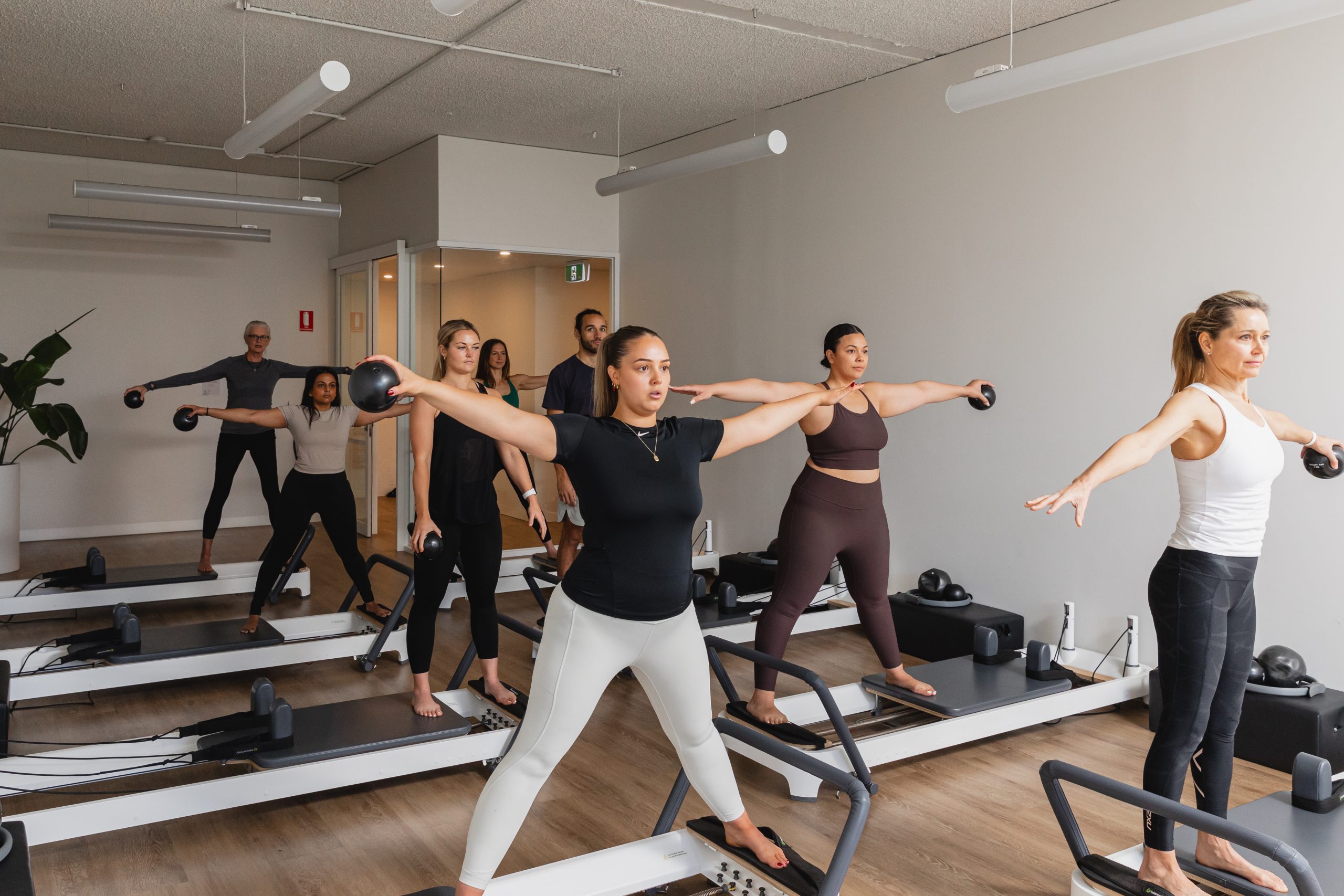
This is where Clinical Pilates earns its place. It is guided by a physiotherapist who knows your specific presentation, which allows precise, progressively loaded movement that builds hip, glute and quad strength without stirring the joint up on the way through. For people who want the heavier end of the same idea, our strength classes take that work into loaded lifting once the knee is ready for it. Either way it is methodical rather than one-size-fits-all, and the loading is deliberate.
Before you can fix a problem you have to understand it. A physiotherapy assessment looks at the whole picture rather than the sore spot: how the knee moves, what is happening at the hip and the foot, how well the glutes load, and what your movement patterns do once you are tired. From there the plan is built around what you actually need, not what the internet thinks you probably have.
Our physiotherapists at Yarraville, Hampton East and Kensington see people at every stage of this, from a first flare of knee pain to post-surgical rehabilitation to athletes managing years of load. The approach does not change: understand it properly, then address it systematically.
And movement beats avoidance. For most knee conditions, graded exposure, meaning a planned and gradual return to the load that hurts, works far better than protecting the knee from activity. Avoiding stairs shrinks what your knee can tolerate, which makes the next flight harder again. You may need some support getting back to them comfortably, but the destination is the stairs, not around them.
Stairs are not your enemy.
Some knee pain settles with minor adjustments. Some needs proper attention. It is worth booking an assessment if:
If the knee is hot and swollen and you feel unwell or feverish, or if you cannot put weight through the leg after a fall or a twist, see a doctor the same day rather than booking a physio appointment. Both are uncommon and both need ruling out first.
None of these are reasons to panic. They are reasons to get clarity instead of guessing.
We hear this one weekly: “I just have bad knees.” It is a phrase that tends to arrive after years of being told that the pain is normal, or that nothing much can be done, or that it is simply part of getting older.
In most cases it is not accurate. The knee is a durable, well-designed joint. Pain is almost always a signal about load, capacity or mechanics rather than a verdict on the joint itself. People in their sixties and seventies regularly make significant improvements in knee pain through structured rehabilitation, including plenty who arrived convinced that ship had sailed. The idea that you simply have to live with it is, for the large majority of people, not true.
What changes the outcome is understanding what is actually happening, and then doing something specific about it.
Knee pain on stairs can feel like a minor inconvenience, and for a while it is. Left alone it tends to widen into a pattern: less exercise, less strength, more compensating through the hip or the lower back, and a slowly narrowing list of things that feel worth doing.
The people who do best here are the ones who take the early signal seriously, not with alarm but with curiosity. They get assessed, they find out what they are working with, and they build a plan. Many are back doing what they want to do within a few months, with a better understanding of their body than they started with.
Knee assessments run at all three studios: Yarraville in Melbourne’s inner west (03 8319 9945), Hampton East in the bayside south east (03 9086 3740), and Kensington in the inner north west (03 8319 9946). Each has a gym floor and Clinical Pilates in the same building, so the strengthening starts where the assessment finished. HICAPS on the spot, Medicare Care Plans welcome.
Book a knee assessment at whichever studio suits, or call and describe what the stairs feel like and how long it has been going on. We will take it from there, and the plan you leave with will be yours rather than a printout.
Because stairs ask far more of the knee. Flat walking bends the loaded knee only about 15 to 20 degrees, while a step up needs 60 degrees or more of loaded bend, with two to four times your body weight passing through the joint. The bigger change is at the kneecap, which is pressed far harder into the groove it runs in as the loaded bend deepens. A knee that copes on the flat can still be exposed on stairs, which usually points to the supporting muscles, the quads, glutes and hip stabilisers, rather than to damage inside the joint.
Generally no. Short-term rest can settle an acute flare, but avoidance lowers what the knee can tolerate, so the next flight feels worse again. A graded return, meaning a planned and gradual increase in how much stair work you do, tends to work better than protecting the joint from it. In the meantime, leading with the stronger leg going up, slowing the descent, and using the handrail take the edge off without giving stairs up altogether.
For most people it is the single most effective thing they can do. The evidence consistently favours progressive strengthening over passive treatments for patellofemoral pain and for knee osteoarthritis. The work usually centres on the quadriceps, gluteal muscles and hip stabilisers, loaded gradually rather than all at once. Most people notice a meaningful change within four to eight weeks of starting a program built for their knee.
Going up, the quadriceps shorten to lift you. Going down, they lengthen under load to brake your descent, which generates higher forces and presses the kneecap harder into its groove. That is why down-stairs pain points more strongly at the patellofemoral joint, and why many people notice the descent first even when both directions are uncomfortable.
Pain at the front of the knee on stairs most commonly points to patellofemoral pain, which is irritation of the kneecap and the groove it moves through. It is typically related to muscle imbalance and load distribution rather than a structural problem, and it responds well to targeted strengthening. Sharp, pinpoint pain there is not in itself a sign of damage.
It depends on the cause and how long it has been there. Most cases are not serious in the sense of needing surgery or indicating major structural damage. Persistent pain that is changing how you move, or pain with swelling, clicking or locking, should be assessed properly rather than managed indefinitely with painkillers and avoidance.
Often, yes. Clinical Pilates at All for One is supervised by a physiotherapist and matched to your presentation, so the loading is controlled and progressive. It builds the hip, glute and quad strength the knee depends on without aggravating the joint in the process, which makes it a practical home for the strengthening part of a knee plan.
Usually yes, with the right guidance. Many people keep training while their knee settles, and staying active generally helps. The key is knowing which activities suit your specific presentation and which need modifying for now. An assessment gives you a clear picture of what is safe and useful versus what is quietly making things worse.
All for One has physiotherapists at three Melbourne studios: Yarraville in the inner west, Hampton East in the bayside south east, and Kensington in the inner north west. Each offers knee assessments and physiotherapist-led Clinical Pilates, with no referral needed to book and HICAPS on the spot.
Physiotherapy - 15/08/2026
Prefer to talk? Yarraville (03) 8319 9945 · Hampton East (03) 9086 3740 · Kensington (03) 8319 9946
Please don’t include medical or health information in this form. For clinical questions or appointments, call your studio or book online. Your message goes straight to the studio you choose.
This site is protected by reCAPTCHA and the Google Privacy Policy and Terms of Service apply.

Specialist care from physios who truly understand women’s bodies.

Senior Women’s Health Physiotherapist
Emily has a deep passion for empowering women to take control of their pelvic health. She creates a warm, judgement-free space where you can talk openly about what’s really going on.
With advanced training in pelvic floor rehabilitation, Emily treats a wide range of conditions including incontinence, prolapse, pelvic pain, and pregnancy-related concerns. She takes the time to really listen, explain what’s happening in your body, and build a treatment plan that fits your life. Whether you’re preparing for birth, recovering postpartum, or navigating menopause — Emily is here to help you feel strong and confident again.

Women’s Health Physiotherapist
Tori is passionate about helping women feel heard and supported through every stage of life. She combines clinical expertise with genuine empathy to deliver care that makes a real difference.
Tori brings a holistic, evidence-based approach to treating pelvic floor dysfunction, pregnancy-related pain, and postnatal recovery. She has a special interest in helping women return to exercise safely after having a baby and supporting those with persistent pelvic pain. Tori believes every woman deserves to understand her body and feel empowered in her recovery — no topic is too awkward, and no concern is too small.