Physiotherapy - 15/08/2026

The single-leg calf raise is the cheapest test in physiotherapy. No equipment, no machine, about a minute of your time, and it tells you more about your lower limb than most people expect. Here are the numbers, where they actually come from, and what to do if yours come up short.
Your calves do a lot of quiet work. The gastrocnemius and soleus, joined to the heel by the Achilles tendon, push you forward with every step, steady your ankle when the ground is uneven, and absorb load each time you land. They are working from the first step of the morning to the last one at night, which is exactly why their endurance, not just their peak strength, is the thing worth knowing.
When that endurance drops away, the complaints tend to be familiar ones:
That’s why the single-leg calf raise is one of our go-to measures. Our physiotherapists use it on everyone from post-operative clients to recreational athletes and marathon runners, because it is quick, needs no equipment, and gives an immediate read on three things at once: strength, endurance, and whether your two legs are still working as a matched pair.
First, the protocol, because it decides the number. The best reference data we have comes from a study of 566 healthy adults aged 20 to 81. They stood on a 10 degree incline board, one leg at a time, with fingertips resting on a wall for balance only, knee and trunk kept straight, lifting the heel as high as possible to a metronome set at 60 rises a minute, and continued to true fatigue. Change any of that, and the number changes with it. Flat floor, bare feet, half height, your own pace, or leaning on the wall for support will all give you a friendlier count than the figures below.
On that protocol, here’s the expected median for an adult of average build and moderate activity, at the start of each decade. Numbers slide down gradually through each decade rather than dropping at your next birthday.
Two things stand out. Men out-repeat women through the younger decades and the gap closes with age, until somewhere around 60 it reverses and women hold their numbers slightly better. And the spread inside every one of those age bands is enormous: the middle 95 percent of 40-year-olds runs from roughly 9 repetitions to roughly 46. A median is where the middle of the crowd sits, not a line you pass or fail.
What moves your number most, apart from age, is how active you are. In the same study, the most active adults managed roughly seven to nine more repetitions than the barely active ones, which is a bigger swing than a decade of ageing. That’s the encouraging part of all this: the trainable input outweighs the one you cannot control.
You can do a serviceable version of this on your kitchen floor, as long as you are not testing a cold calf, because warming up first changes what the muscle will give you.
Count both sides and write the two numbers down. If you want to compare yourself to the figures above, you need the incline board and the metronome, so treat a flat-floor result as your own baseline rather than a score against the population. If you would rather have the number measured than estimated, our strength testing appointment puts figures on your lower limb strength and balance and sends you home with a report to retest against. Either way, the same test repeated the same way in six weeks is the measurement that actually matters.
Normative data tells you where you sit among everyone else. It doesn’t tell you whether your calves are ready for what you are asking of them. For that, our physiotherapists use training targets rather than averages, and they sit higher than the medians on purpose. These are on the same standardised test as the numbers above, so single leg, full height, one rise a second. On a flat floor they will come more easily.
The reason the running numbers climb is load. Every stride sends force through the calf and Achilles that is commonly estimated at somewhere between six and eight times body weight, and higher again at speed. Multiply that by tens of thousands of strides in a marathon build and you can see why an endurance runner who fatigues at 18 reps a side tends to meet us eventually. Being able to hold 35 or more strong, controlled repetitions per leg suggests your calves have the capacity for that repetition, rather than just enough to get through the first half of it.
If you fatigue well before the typical range for your age or your sport, it’s worth understanding why before you simply do more. The usual explanations are:
The side-to-side comparison is often the most useful thing on the page. A gap of more than about five or six repetitions between legs is worth investigating, and worth taking seriously if it is on the side you once hurt. Below that, be careful how much you read into it: when researchers retested the same healthy people a week apart, individual results moved by up to about six repetitions either way, so small differences are as likely to be noise as news.
One thing that’s never just noise is pain. Calf raises should feel like hard work, not like a sharp catch in the tendon, a pinch at the front of the ankle, or an ache that lingers the next day. If that is what you are getting, the number is the wrong thing to chase and an assessment is the right place to start
Two things do not belong in this article at all. A calf that is swollen, warm, red or tender on one side only, especially after surgery, a long flight or a spell of bed rest, needs same-day medical attention rather than exercise. So does a sudden pop or a feeling of being kicked in the back of the ankle, followed by trouble pushing off. Neither is a training problem.
Our physiotherapists use a progression rather than a single exercise, because the calf complex needs to be strong through height, through speed, and under load. A typical order looks like this.
Double-leg raises. Both feet on the ground, full height, building basic endurance and getting the ankle used to the range.
Single-leg raises. Shift to one foot. This is where most people discover the gap between their sides, and where full height and control matter more than the count.
Weighted raises. Add dumbbells, a barbell or a machine once the bodyweight version feels genuinely easy, so the muscle keeps being asked for more.
Tempo and eccentric work. Slow, controlled lowering phases. This is the part that builds tendon capacity, and it’s the part almost everybody skips.
Functional integration. Take the strength back out into walking, hills, stairs, running and jumping, so it shows up where you need it.
Form and control beat pure numbers at every step of that. A set of 30 half-height bounces is worth less than 12 full-height, slow, honest repetitions, and the count you report at your next test is only meaningful if you are measuring the same movement.
This is a different question to the test, and it has a much simpler answer. For general strength and endurance, most people do well on 2 to 3 sets of 15 to 25 quality repetitions, 2 to 3 times a week, with a slow lower of about three seconds and a brief pause at the top. That is enough to drive change, and short enough that you’ll actually do it.
A daily maximal set is not necessary, and for a lot of people it is counterproductive. Muscle and tendon adapt during the recovery between hard efforts, not during the effort itself, so training a fatigued calf every day tends to produce a sore Achilles rather than a stronger one. It is worth remembering that soreness is a poor measure of whether training worked in the first place. If you like a daily habit, keep the daily version easy and sub-maximal, and let two or three days a week be the ones where you actually work.
Do both knee positions if you can. Straight-knee raises bias the gastrocnemius; bent-knee raises, done seated or in a half squat, bias the soleus, which is the endurance muscle underneath and the one most often neglected. And progression beats volume every time. Adding a fourth set of the same easy raises does much less than making the same three sets harder, whether that is by slowing the lower, pausing at the top, standing on a step for more range, or adding weight.
Once you can comfortably manage 25 or more good single-leg repetitions and you are not chasing an endurance target, doing 40 of them proves stamina you already have. That’s the point to add load rather than reps.
For size and strength, work in the range of 8 to 15 slow repetitions with enough weight that the last two or three are genuinely hard, for three or four sets, two or three times a week. Hold a dumbbell, use a calf raise machine, or load a barbell if you have one, and take the full range every time: heel below the level of the step, then all the way up onto the ball of the foot with a pause. Partial reps are where calf training goes to die.
The honest part is the timeline. Calves are stubborn. They are built for thousands of low-effort contractions a day, so they take a fair bit of convincing that anything new is happening, and visible change is measured in months rather than weeks. Consistency over a few months does far more than any clever variation, which is also why calf work sits inside a broader program at our Strength classes rather than being something you bolt on and forget.
This one arrives via social media, usually as a claim that calf raises beat a sauna for circulation. It’s worth unpicking, because half of it is real physiology and the other half is a false choice.
What the calf raise side gets right. The calf muscle pump is genuinely a thing. Deep veins run through the calf muscles, and one-way valves mean that every contraction squeezes blood upward toward the heart. That is why the calf is sometimes called the second heart, and why standing still for hours leaves your ankles swollen while walking does not. There is also early work on the soleus specifically: a small 2022 study of 25 volunteers found that a sustained, low-effort seated soleus contraction could keep local oxidative metabolism elevated for hours while sitting, with improvements in blood glucose and fat handling after a meal. It’s a genuinely interesting finding, and it’s also one small laboratory study of hours of continuous contraction, not a set of 20 calf raises. Treat it as promising rather than settled.
What the sauna side gets right. Sauna has its own evidence, and most of it is observational. The best known comes from a long-running Finnish cohort of about 2,300 middle-aged men, where frequent sauna bathing was associated with lower cardiovascular and all-cause mortality over roughly 20 years of follow-up. Association is not proof of cause: people who use a sauna four or more times a week may differ from those who do not in ways the statistics cannot fully account for. Smaller experimental studies do show real short-term effects on heart rate, blood pressure and blood vessel function, which is a plausible mechanism, but the mortality findings should be read as a link rather than a guarantee. Worth knowing too that this research is on traditional Finnish sauna, so it does not transfer neatly to an infrared cabin, and that a long sit in the heat costs you enough fluid to be worth folding into how much water you need in a day.
Why the comparison doesn’t work. They’re not doing the same job. A calf raise is a muscle contraction that builds tissue capacity, assists venous return and trains the tendon that has to survive your next run. A sauna is passive heat that lifts your heart rate and dilates your blood vessels while you sit still. Neither one substitutes for the other, and neither one substitutes for walking, running or lifting, which remains the part with the strongest evidence behind it. If the choice is framed as calf raises or sauna, the useful answer is that the calf raises are the ones building something.
When people think about ageing well, they picture heart health and nutrition. The lower leg rarely gets a mention, which is odd, because lower-limb strength and endurance track closely with the things that decide how independent you stay.
Your calves help move blood back up. Every contraction assists venous return from the legs, which is why calf activity is associated with less swelling and why long stretches of sitting still are not kind to the venous system.
They keep you steady. Calf endurance is closely linked with balance and walking speed, and walking speed is one of the more reliable markers of long-term independence in older adults. Steadier ankles also mean a better chance of catching yourself when you trip.
They fade early if you let them. Muscle mass declines with age, and the lower legs are often among the first areas to lose it. Keeping the calves strong helps preserve the walking speed and the everyday function that depend on them.
They make the rest possible. Stairs, hills, long days on your feet, holidays where you actually walk around. None of it happens without calves that can keep going, and a few minutes of strengthening a week is a small price for that. If the stairs already hurt rather than simply tire you, that is a different signal, and knee pain going up stairs is where we have written about it.
To be clear about what this is and is not: strong calves are associated with better mobility and balance as you age. No exercise prevents disease on its own, and nobody can promise you a set of years. What calf work can do is keep the machinery that carries you around in good order for longer.
You won’t notice your calves fading. You’ll notice the stairs.
If you tested well and just want to keep it that way, the dose above is the whole plan. Two or three times a week, both knee positions, full height, slow lower. If you would rather somebody else owned the progression, personal training does that one to one and adjusts it as your numbers move.
If one side was clearly weaker, if the number was well under the range for your age, or if it hurt, that is worth an assessment. A physiotherapy appointment gives you the reason behind the number: ankle range, tendon load tolerance, how the calf behaves under fatigue, and what the rest of the leg is doing to compensate. You go home with a program built for the gap you actually have, not the average one.
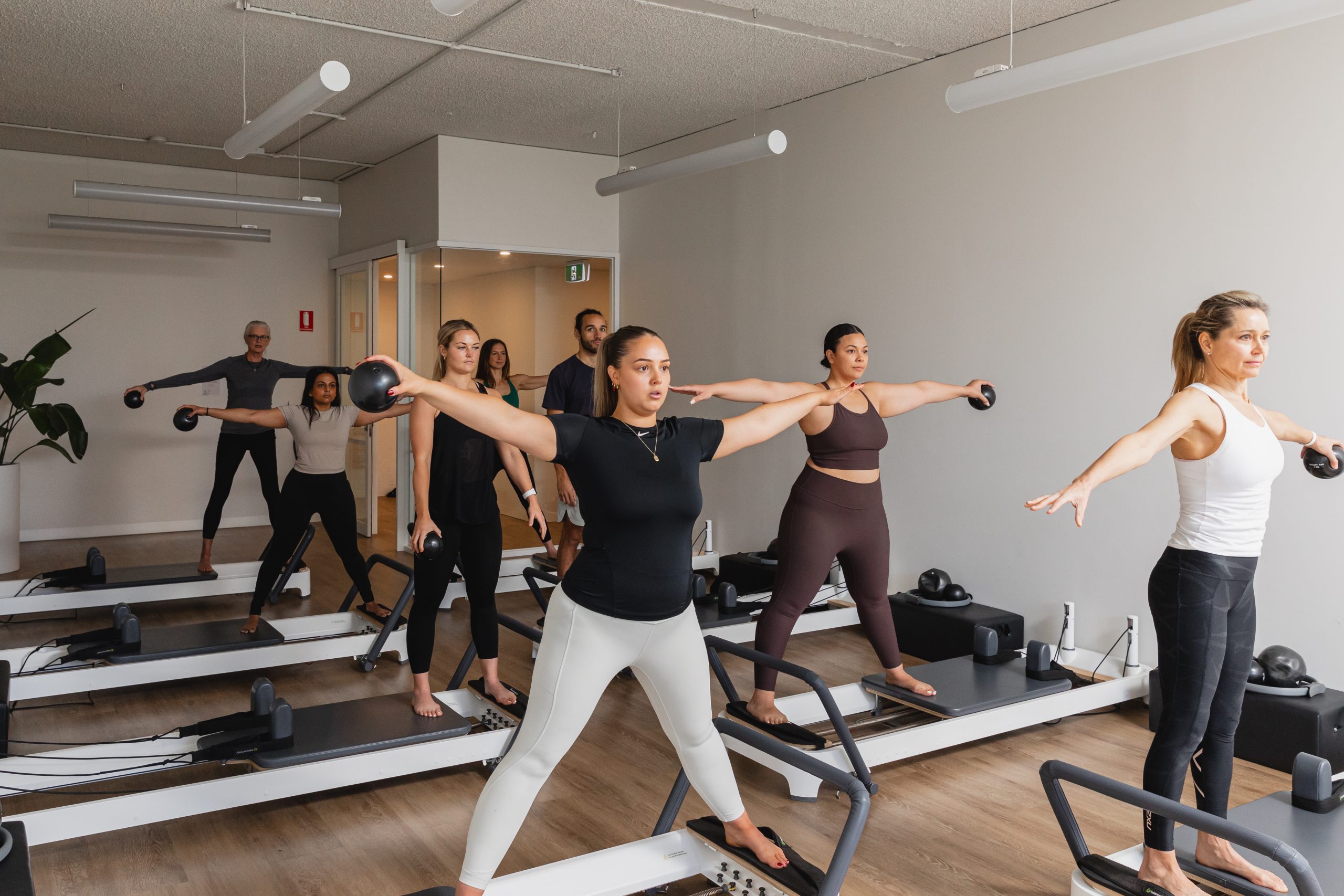
And if the honest problem is that you won’t do it on your own, put it somewhere with other people in the room. Our Strength classes build lower-limb strength progressively under a coach who can see whether you are reaching full height, and you can book a class at Yarraville or Hampton East whenever it suits.
For general strength and endurance, 2 to 3 sets of 15 to 25 quality repetitions, 2 to 3 times a week, with a slow lower of about three seconds. A daily maximal set is not necessary, because muscle and tendon adapt during recovery rather than during the effort. If you want a daily habit, keep the daily version easy and let two or three days a week be the harder ones.
On a standardised test, single leg, on a 10 degree incline, to a metronome at 60 rises a minute, the median is about 37 repetitions for men and about 31 for women at age 20, falling to about 24 for men and 23 for women by age 50. The spread within every age group is wide, so treat these as the middle of the crowd rather than a pass mark, and pay more attention to how your own number changes over time.
They do different jobs, so the comparison doesn’t really hold. Calf raises are a muscle contraction that builds strength and tendon capacity while the calf muscle pump assists blood return from the legs. A sauna is passive heat that raises heart rate and widens blood vessels, and its cardiovascular evidence is largely observational, meaning it is associated with benefit rather than proven to cause it. Neither replaces the other, and neither replaces walking or lifting.
Because two legs hide the problem. On both feet you can quietly shift weight onto the stronger side, and most healthy adults can keep going long past the point where the test tells you anything useful. Single leg loads the calf with your full body weight, exposes the difference between your sides, and matches how you actually run and walk, which happens one leg at a time.
A gap of more than about five or six repetitions is worth looking into, especially on a side you’ve injured before. Below that, be cautious, because repeat testing of the same healthy person can vary by up to about six repetitions on its own. A real imbalance usually reflects an old injury, a period of reduced loading, or restricted ankle movement, and it raises the risk of overuse problems on one side.
Both, depending on how you load them. High-repetition bodyweight raises train endurance. To build muscle, add weight once 25 or more single-leg repetitions feel easy, and work in the range of 8 to 15 slow repetitions where the last few are genuinely hard. Calves are stubborn and respond to consistency over months rather than weeks.
Hard work is expected. Sharp pain in the tendon, a pinch at the front of the ankle, or an ache that lingers into the next day is not, and pushing through it usually makes the tendon worse rather than stronger. Stop chasing the number and get it assessed, because the fix is often ankle range or load management rather than more repetitions.
Most people see a measurable change in repetitions within six to eight weeks of consistent work, two or three times a week. Visible muscle change takes longer, usually a few months. Retest the same way you tested the first time, because a different pace, height or surface will change the number more than your training does.
If your number was low, or one side clearly lagged, our physiotherapists will work out why and build you a program aimed at that gap. If you’d rather build it in a room with other people, book into a Strength class and start there.
Physiotherapy - 15/08/2026
Prefer to talk? Yarraville (03) 8319 9945 · Hampton East (03) 9086 3740 · Kensington (03) 8319 9946
Please don’t include medical or health information in this form. For clinical questions or appointments, call your studio or book online. Your message goes straight to the studio you choose.
This site is protected by reCAPTCHA and the Google Privacy Policy and Terms of Service apply.

Specialist care from physios who truly understand women’s bodies.

Senior Women’s Health Physiotherapist
Emily has a deep passion for empowering women to take control of their pelvic health. She creates a warm, judgement-free space where you can talk openly about what’s really going on.
With advanced training in pelvic floor rehabilitation, Emily treats a wide range of conditions including incontinence, prolapse, pelvic pain, and pregnancy-related concerns. She takes the time to really listen, explain what’s happening in your body, and build a treatment plan that fits your life. Whether you’re preparing for birth, recovering postpartum, or navigating menopause — Emily is here to help you feel strong and confident again.

Women’s Health Physiotherapist
Tori is passionate about helping women feel heard and supported through every stage of life. She combines clinical expertise with genuine empathy to deliver care that makes a real difference.
Tori brings a holistic, evidence-based approach to treating pelvic floor dysfunction, pregnancy-related pain, and postnatal recovery. She has a special interest in helping women return to exercise safely after having a baby and supporting those with persistent pelvic pain. Tori believes every woman deserves to understand her body and feel empowered in her recovery — no topic is too awkward, and no concern is too small.